It is your land and your car, so it is easy to assume that what sits behind the barn or beside the garage is nobody’s business but yours. Under Ohio law, that is not entirely true.
Ohio has a statute that deals specifically with junk motor vehicles kept in the open on private property. It gives sheriffs, police chiefs, township trustees, and zoning officials the power to send a formal notice, and it puts a firm deadline on the property owner once that notice is received.
This guide explains how the law defines a junk vehicle, what the notice means, how long you have to respond, and what your options are. It is general information, not legal advice. If you have already received a notice, read it carefully and contact the office that sent it with any questions.
How Ohio Law Defines a Junk Motor Vehicle
Not every old car is a junk motor vehicle in the legal sense. Under Ohio Revised Code 4513.65, which borrows its criteria from section 4513.63, a vehicle must meet every one of these conditions:
- It is three years old or older.
- It is extensively damaged. The statute gives missing wheels, tires, motor, or transmission as examples.
- It is apparently inoperable.
- It has a fair market value of $1,500 or less.
- It has been left uncovered in the open on private property for more than 72 hours, with the permission of the person who has the right to possess that property.
That fifth point surprises people. The law applies even when the vehicle is on your own land with your full consent. Ownership of the property is not a defense.
The statute also carves out a few situations where it does not apply:
- Licensed junk yards and scrap metal processing facilities, which are regulated separately
- Collector’s vehicles, which receive specific protection under state law
- Vehicles that are part of a bona fide commercial operation on certain property not otherwise regulated by a governmental authority
A daily driver with a dead battery does not fit the definition. A stripped sedan on blocks that has not moved in years very likely does.
What Happens After a Notice: The 10-Day Deadline
Once you receive a notice, you have ten days to act. The process laid out in the statute is short and specific.
Who can send it. The list is long. It includes the county sheriff, the chief of a municipal police department, a state highway patrol trooper, a board of township trustees, the legislative authority of a city or village, and the zoning authority of a township or municipality.
How it arrives. The notice is sent by certified mail with a return receipt requested. It goes to the person who has the right to possess the property where the vehicle sits, which may or may not be the vehicle’s owner.
What it requires. Within ten days of receiving the notice, the vehicle must either be covered by being housed in a garage or other suitable structure, or be removed from the property.
What happens if you do nothing. Willfully leaving a junk motor vehicle uncovered in the open for more than ten days after receiving the notice is a minor misdemeanor. The vehicle still sitting there is treated as prima facie evidence that the failure was willful.
How the penalties add up. Under Ohio Revised Code 2929.28, the fine for a minor misdemeanor is not more than $150, and court costs are separate. The junk vehicle statute then treats each additional 30-day period the vehicle remains as a new offense.
One fine may not sound like much. Repeated offenses, court costs, and the time involved cost far more than the vehicle is worth.
Your Options for Complying
The statute gives you two ways to comply, and a third follows from how a junk vehicle is defined.
House it. The wording matters here. The law says the vehicle must be covered “by being housed in a garage or other suitable structure.” Do not assume a tarp or a fitted car cover satisfies that language. If you plan to keep the vehicle, ask the office that sent the notice what it will accept.
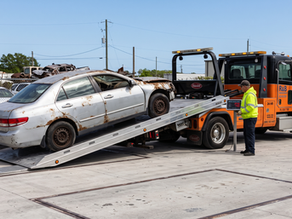
Remove it. Taking the vehicle off the property ends the issue. For a car that does not run, that means arranging a tow, which is where a junk car buyer with free pickup makes the process simple.
Repair it. A vehicle that runs and is no longer extensively damaged does not meet the definition. This only makes sense when the repair cost is reasonable compared with what the car is worth, and ten days is not much time for a major project. Confirm with the issuing office before relying on this route.
Whichever option you choose, keep records. Save the notice, write down the date you received it, and keep a receipt or bill of sale showing when the vehicle left your property.
Local Rules Can Be Stricter Than State Law
The state statute is the baseline, not the whole picture. Much of north-central Ohio is township land, and townships have their own authority.
Under Ohio Revised Code 505.173, a board of township trustees may adopt resolutions regulating the storage of junk motor vehicles in the unincorporated area of the township. That section differs from the state rule in three important ways:
- A broader definition. A vehicle qualifies if it is three model years old or older, apparently inoperable, and extensively damaged. There is no $1,500 value test.
- Faster penalties. A violation of a township resolution is a minor misdemeanor, and each day the violation continues is a separate offense.
- Court action. Trustees may also seek an injunction or an abatement order to stop the storage.
Cities and villages can have their own property maintenance and zoning rules as well. If you live inside municipal limits, check your local codified ordinances or call the zoning office.
A note on collector’s vehicles. State law bars local governments from preventing you from keeping a collector’s vehicle on private property. They may, however, require an unlicensed collector’s vehicle stored in the open to be concealed by a building, fence, vegetation, or similar screening. In townships, a collector’s vehicle that meets all three junk criteria above can be regulated like any other junk vehicle.
If the vehicle is not yours. A different rule covers vehicles someone else left behind. A junk vehicle left on private property for 48 hours or longer without the property holder’s permission is an abandoned junk motor vehicle under section 4513.63, and law enforcement can order it photographed and disposed of. Call your sheriff or police department. Do not try to sell a vehicle you do not own.
Why Selling the Vehicle Is Usually the Simplest Fix
For most people facing a notice, selling the vehicle solves the problem fastest. Building a garage in ten days is not realistic, and a car valued at $1,500 or less rarely justifies a major repair.
Selling it to a junk car buyer removes the vehicle, ends the compliance issue, and puts money in your pocket instead of taking it out. MK Recycling offers junk car removal with free pickup across Bellevue and the surrounding area, so a car that does not run is not an obstacle.
A few steps keep the sale moving inside the deadline:
- Find the title now. Missing paperwork is the most common delay. If you cannot locate it, read our guide on selling a car without a title in Ohio right away.
- Call for a quote. Have the year, make, model, and condition ready. Our post on what determines your junk car’s value explains what goes into the offer.
- Mention your deadline. If you have received a notice, say so when you call so pickup can be scheduled with the date in mind.
- Prepare the vehicle. Remove plates and personal items before the truck arrives. Our pre-pickup checklist covers the rest.
- Keep your receipt. It is your proof of the date the vehicle left the property.
The best time to act is before a notice ever arrives. If a vehicle on your property already fits the definition above, removing it now costs nothing and avoids the certified letter entirely. For a full walkthrough of the process, see what to expect from junk car removal in Bellevue.
Frequently Asked Questions
Can I keep a junk car on my own property in Ohio?
Only if it is housed in a garage or other suitable structure, or falls under an exception such as a collector’s vehicle. A vehicle that meets the legal definition and sits uncovered in the open can be the subject of a notice, even on your own land.
How long do I have after a junk vehicle notice?
Ten days from the date you receive it, under Ohio Revised Code 4513.65. Township resolutions and municipal ordinances may set their own terms, so read the notice itself.
What is the fine for a junk vehicle in Ohio?
A violation of the state statute is a minor misdemeanor, with a fine of not more than $150 plus court costs. Each additional 30 days is a separate offense. Under a township resolution, each day can be a separate offense.
Does a car cover or tarp count as covering the vehicle?
The state statute refers to housing the vehicle in a garage or other suitable structure. Ask the office that issued the notice before relying on a tarp.
Does the law apply to a car that runs?
The definition requires the vehicle to be apparently inoperable and extensively damaged. A running, intact vehicle does not meet it, although local rules on unlicensed vehicles may still apply.
Clear the Vehicle Before It Becomes a Legal Problem
A junk vehicle on your property is more than an eyesore. Under Ohio law it can become a deadline, a court date, and a recurring fine.
MK Recycling is a family-owned business with more than 24 years of experience, located at 938 St. Rt. 113 in Bellevue. We offer top-dollar payouts and free pickup for junk cars in Bellevue, Sandusky, Norwalk, Fremont, Clyde, Port Clinton, and the surrounding communities.
Call (419) 706-2807 or email tpwurm86@gmail.com to get a quote and schedule your pickup.
Comments